Topic Definitions
STEEP

STEEP
is a framework for analyzing the external environment based on five factor groups:
Social, Technological, Economic, Environmental, Political.
It helps identify global trends and external influences that may affect a project.
DESTEP

DESTEP
is an extended environmental analysis model that includes:
Demographic, Economic, Social, Technological, Ecological, Political factors.
It provides a more detailed understanding of population characteristics, markets, and the environment.
Psychographics
Psychographics
is a method of segmenting customers based on:
values,
interests,
lifestyle,
motivations,
behavioral attitudes.
It explains why people behave or make decisions in certain ways.
MMM

Marketing Mix Modeling
Marketing Mix Modeling is an analytical method used to measure how different marketing activities (advertising, promotions, discounts, PR, etc.) influence sales.
It helps determine which channels contribute most to overall performance.
Neural attribution
Neural attribution
Neural attribution uses neural networks to identify
which specific marketing actions or factors influenced user behavior (such as a purchase or click).
It is a more advanced and accurate attribution method than traditional models.
Sentiment AI
Sentiment AI
Sentiment AI is artificial intelligence that detects the emotional tone of text — positive, negative, or neutral.
It is used to analyze:
customer reviews,
social media posts,
comments,
brand sentiment.
SO–WO–ST–WT hypotheses
SO–WO–ST–WT hypotheses
These are four types of strategic hypotheses generated from a SWOT analysis:
They help transform analytical insights into strategic actions.
customer reviews,
social media posts,
comments,
brand sentiment.
Viral loops
Viral loops
are mechanisms where existing users naturally bring in new users, creating exponential growth.
Example: users share content that attracts more users (TikTok, Instagram Reels, memes).
Referral loops
Referral loops
occur when new users join through recommendations or invitations from existing users, usually motivated by rewards or bonuses.
Example: “Invite a friend and get a discount.”
Product triggers
Product triggers
are actions or events inside or outside the product that stimulate user engagement or re-engagement.
Examples:
push notifications,
email reminders,
progress milestones,
in-app events.
Behavioral nudges
Behavioral nudges
are small psychological design cues that encourage users to take a desired action without restricting their freedom of choice.
Automated attribution
Automated attribution
is a system-driven process that automatically determines
which marketing interactions (ads, emails, pages, touchpoints) contributed to a user’s conversion.
It identifies the channels that deserve credit for a sale or action.
W–T risk
W–T risk
refers to risks that arise from a combination of:
These are the most critical risk scenarios where internal limitations amplify the negative impact of external threats.
STEEP
is a framework for analyzing the external environment based on five factor groups:
Social, Technological, Economic, Environmental, Political.
It helps identify global trends and external influences that may affect a project.
DESTEP
is an extended environmental analysis model that includes:
Demographic, Economic, Social, Technological, Ecological, Political factors.
It provides a more detailed understanding of population characteristics, markets, and the environment.
Psychographics
is a method of segmenting customers based on:
values,
interests,
lifestyle,
motivations,
behavioral attitudes.
It explains why people behave or make decisions in certain ways.
Marketing Mix Modeling
Marketing Mix Modeling is an analytical method used to measure how different marketing activities (advertising, promotions, discounts, PR, etc.) influence sales.
It helps determine which channels contribute most to overall performance.
Neural attribution
Neural attribution uses neural networks to identify
which specific marketing actions or factors influenced user behavior (such as a purchase or click).
It is a more advanced and accurate attribution method than traditional models.
Sentiment AI
Sentiment AI is artificial intelligence that detects the emotional tone of text — positive, negative, or neutral.
It is used to analyze:
customer reviews,
social media posts,
comments,
brand sentiment.
SO–WO–ST–WT hypotheses
These are four types of strategic hypotheses generated from a SWOT analysis:
They help transform analytical insights into strategic actions.
customer reviews,
social media posts,
comments,
brand sentiment.
Viral loops
are mechanisms where existing users naturally bring in new users, creating exponential growth.
Example: users share content that attracts more users (TikTok, Instagram Reels, memes).
Referral loops
occur when new users join through recommendations or invitations from existing users, usually motivated by rewards or bonuses.
Example: “Invite a friend and get a discount.”
Product triggers
are actions or events inside or outside the product that stimulate user engagement or re-engagement.
Examples:
push notifications,
email reminders,
progress milestones,
in-app events.
Behavioral nudges
are small psychological design cues that encourage users to take a desired action without restricting their freedom of choice.
Automated attribution
is a system-driven process that automatically determines
which marketing interactions (ads, emails, pages, touchpoints) contributed to a user’s conversion.
It identifies the channels that deserve credit for a sale or action.
W–T risk
refers to risks that arise from a combination of:
These are the most critical risk scenarios where internal limitations amplify the negative impact of external threats.
Structure of Modern Marketing Analysis #
Modern marketing analysis within the Total Project Management Framework (TPmF) is not a standalone study, but a system of interconnected steps that progressively narrow the field of uncertainty —
from global trends and the macro environment to competitive strategy and growth tools.
Each step serves a specific purpose and forms the “input” for the next one.
The logic flows from:
Environment
Customer
Market
Strategy

Section 1. Macro Factors Analysis #
Tools and Methods:
-

PESTEL Analysis
a basic framework for analyzing the external environment.
-

Scenario Trend Scan (STEEP/DESTEP)
identification of long-term trends and early signals.
-

Cross-Impact Assessment
evaluation of how factors interact (e.g., how technological progress affects legislation).
-
Sensitivity Mapping
visualization of which scenarios are most risky or promising.
The results of this stage serve as the foundation for identifying market opportunities and risks in competitive analysis.
Section 2. Customers’ Needs & Unique Selling Proposition #
Tools and Methods:
-

Segmentation & Personas
identifying customer groups based on demographic, behavioral, and psychographic characteristics.
-
JTBD (Jobs To Be Done)
analyzing the context in which the customer “hires” the product to accomplish a task.
-
Customer Journey Map (CJM)
visualizing the customer’s path from need awareness to post-purchase experience.
-

Value Proposition Canvas (VPC) → USP
aligning customer pains and product value into a cohesive offering.
-

Vibe & Cultural Factors
emotional codes, cultural markers, and references that shape the brand’s “atmosphere.”
Customer expectation data becomes the basis for building positioning and conducting competitive analysis.
Section 3. Competitive Analysis & OSINT #
Tools and Methods:
-

Micro-environment Mapping
mapping suppliers, partners, customers, substitutes, and competitors.
-

Competitive Map (Value–Price or Feature–Benefit)
visual comparison of players’ positions.
-

Porter’s Five Forces
pressure from suppliers, customers, substitutes, new entrants, and the level of intra-industry rivalry.
-

Extended Data-Driven SWOT Analysis:
deep SWOT with digital metrics and data analytics.
-

CSF (Critical Success Factors)
key success criteria in the market.
-

CPM (Competitive Profile Matrix)
comparing us and competitors across CSFs.
-

Competitive Polygon
visualization of strengths and weaknesses.
-

Integration of O/T
adding external factors from PESTEL.
-

Strategic SWOT Matrix (Analytical)
generating S–O, S–T, W–O, and W–T hypotheses.
-

Benchmarking & AI Analytics
analysis of digital data, trends, reviews, and attribution (MMM, neural attribution, sentiment AI).
Customer expectation data becomes the basis for building positioning and conducting competitive analysis.
Section 4. Formulate Competitive Marketing Strategy #
Tools and Methods:
-

Interpret Strategic SWOT Hypotheses → Strategic Goals
prioritizing hypotheses and setting measurable objectives.
-

Mission & Vision
defining the long-term purpose and the desired future state.
-

STP (Segmentation → Targeting → Positioning)
selecting target segments and building positioning.
-

Growth Strategy (Ansoff Matrix)
choosing growth scenarios: market penetration, product development, market development, diversification.
-

Growth Marketing System*
a systematic growth cycle: hypothesis creation, A/B tests, iterations, analytics.
-

Growth Hacking
a growth accelerator: short, low-cost experiments with high viral potential (referral loops, viral loops, product triggers, behavioral nudges).
-

Branding & Vibe Positioning
emotional brand identity, cultural code, product atmosphere.
-

Ethical & Sustainable Marketing
incorporating transparency, sustainability, and trust principles.
-

AI-Driven Measurement & Risk Framework
data-driven management: KPIs, automated attribution, W–T risk modeling from SWOT.
Difference Between Growth Marketing and Growth Hacking: #
Growth Marketing #
is a systematic growth process.
where hypotheses, experiments, and A/B tests are built into a continuous cycle.
It is part of the strategic block, forming a sustainable growth-management system.
Growth Hacking #
is an experimental growth accelerator
with minimal resources: testing hypotheses through unconventional, rapidly deployable tools. It is a “tactical booster” embedded within Growth Marketing as a specialized toolkit.
These outputs transition into the implementation phase: Tactical Marketing (8P) and Marketing Communications.
Structure of Modern Marketing Analysis #
Each section logically follows from the previous one, and all outputs consecutively become inputs for the next level.

- СHAPTER 1 → Macro Factors → Opportunities & Threats (SWOT O/T)
- СHAPTER 2 → Customers & USP → Strengths & Weaknesses (SWOT S/W)
- СHAPTER 3 → SWOT + Strategic Matrix → Strategic Hypotheses
- СHAPTER 4 → Interpret SWOT Hypotheses → Strategy → KPIs → Execution
Decision Framework #
The Research phase in the Total Project Management Framework is designed to analyze the market environment, identify customer needs, assess competition, and shape strategic directions.
The project step Choose & Approve Research Methods helps stakeholders determine:
-
whether research is required,
-
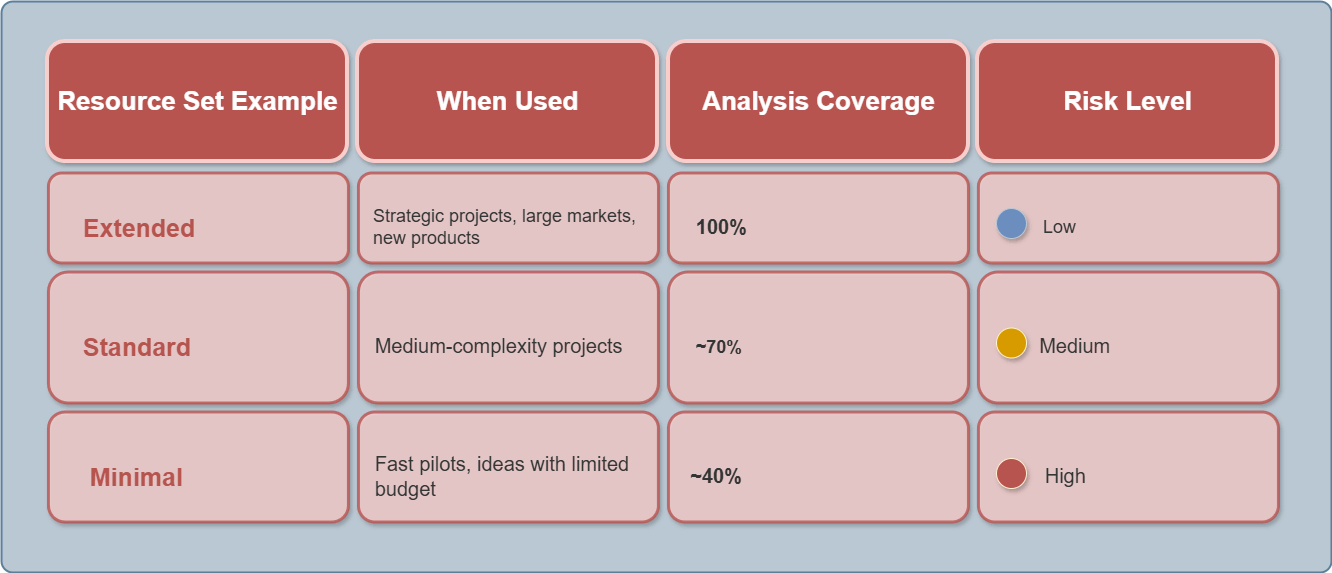
the appropriate scope (Minimal, Standard, Extended),
-
and what risks arise when the scope of analysis is reduced.
The system displays both the analysis coverage level (%) and the incompleteness risk (%), helping to find the right balance between research depth and available resources. It also shows how reducing the scope increases risk and suggests a minimal set of tools that can always be completed with the help of an AI assistant.
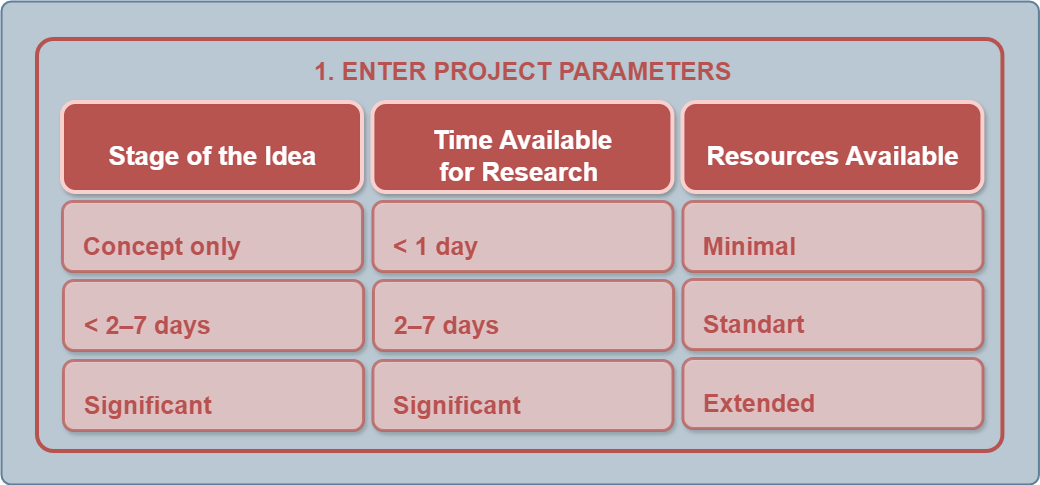
When selecting a Resource Set, three parameters are taken into account:
-
Time available for research.
-
Resources, including budget and data access.
-
Required decision accuracy (which defines the acceptable risk level).
Context of Use:
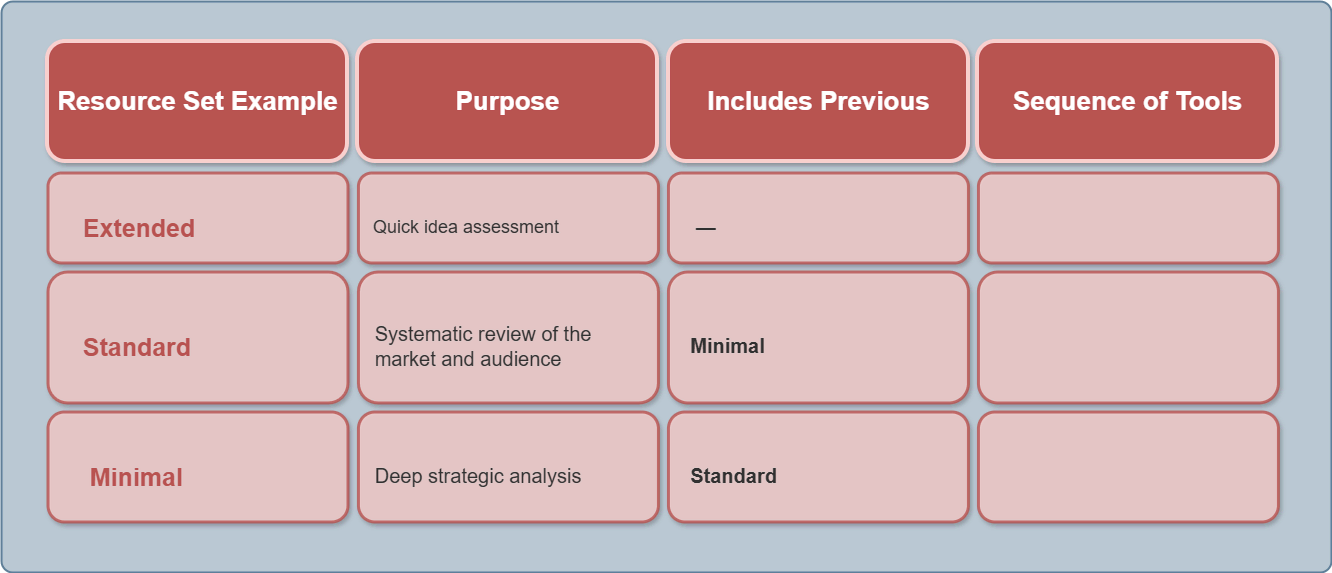
Purpose:
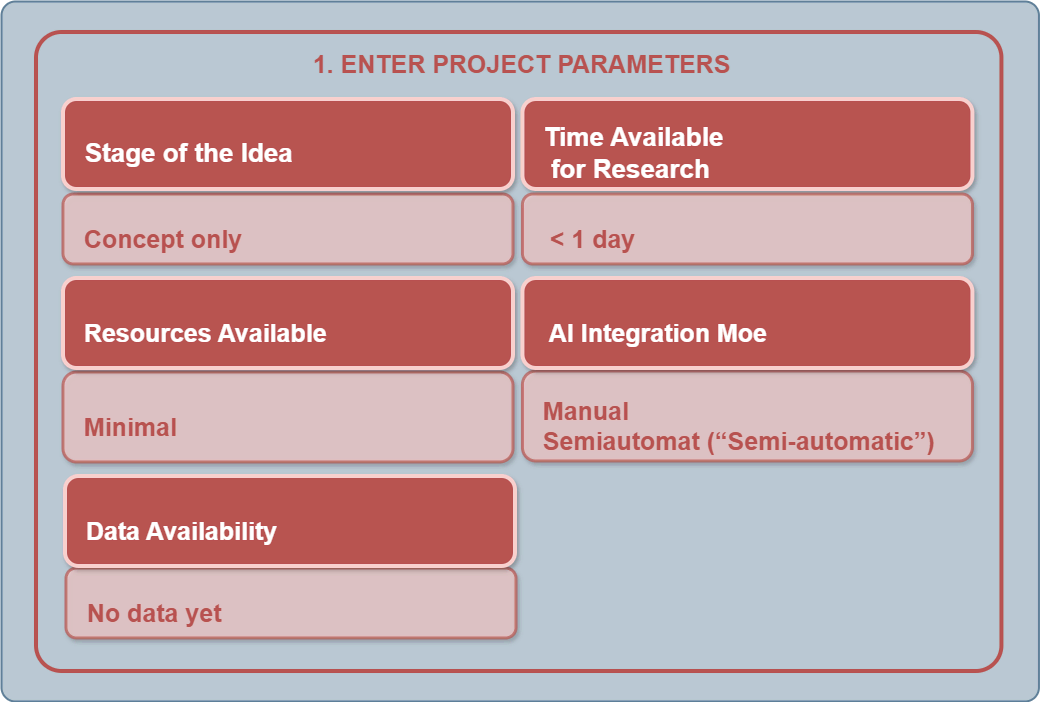
Step 1 — Define Research Parameters #
The user enters the initial project parameters:
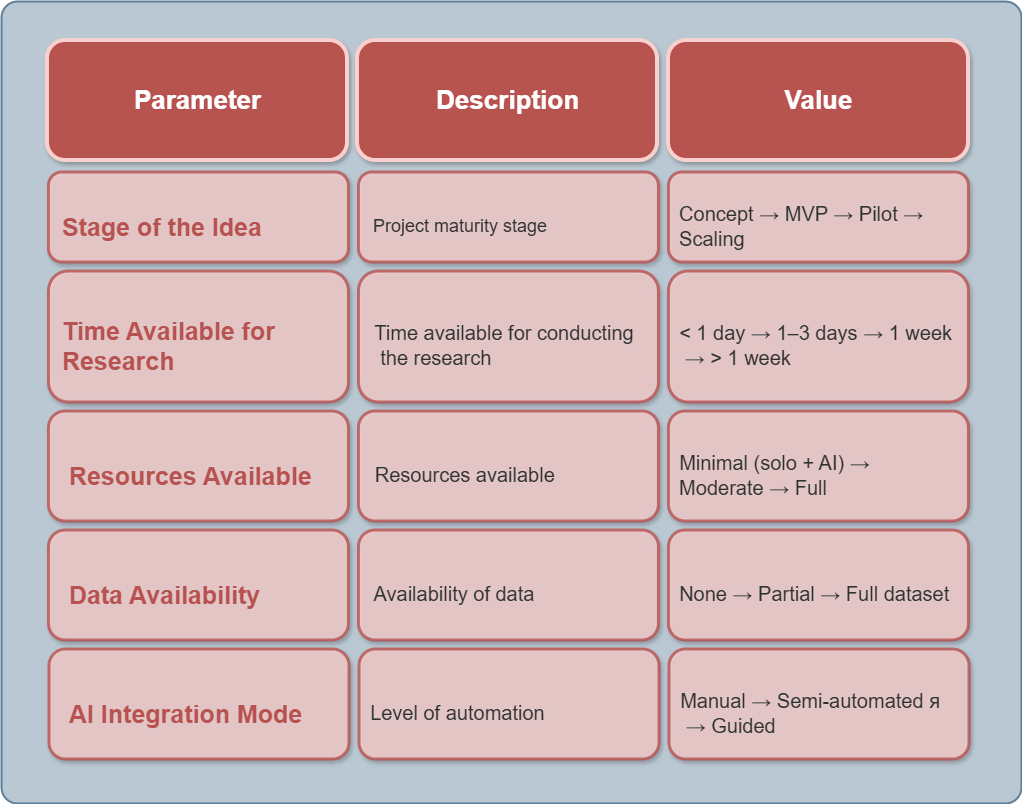
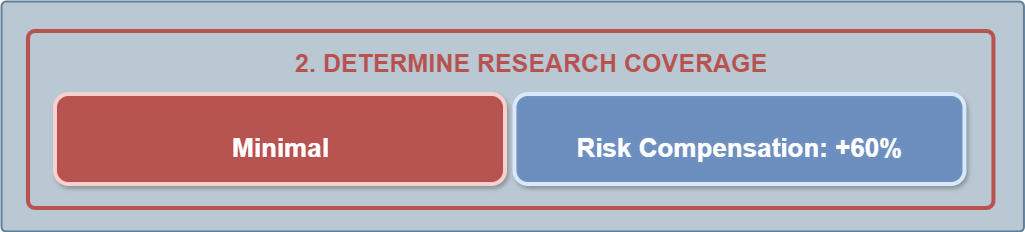
After the input is provided, the system calculates the Research Coverage level and displays the change in risk (Risk Compensation).
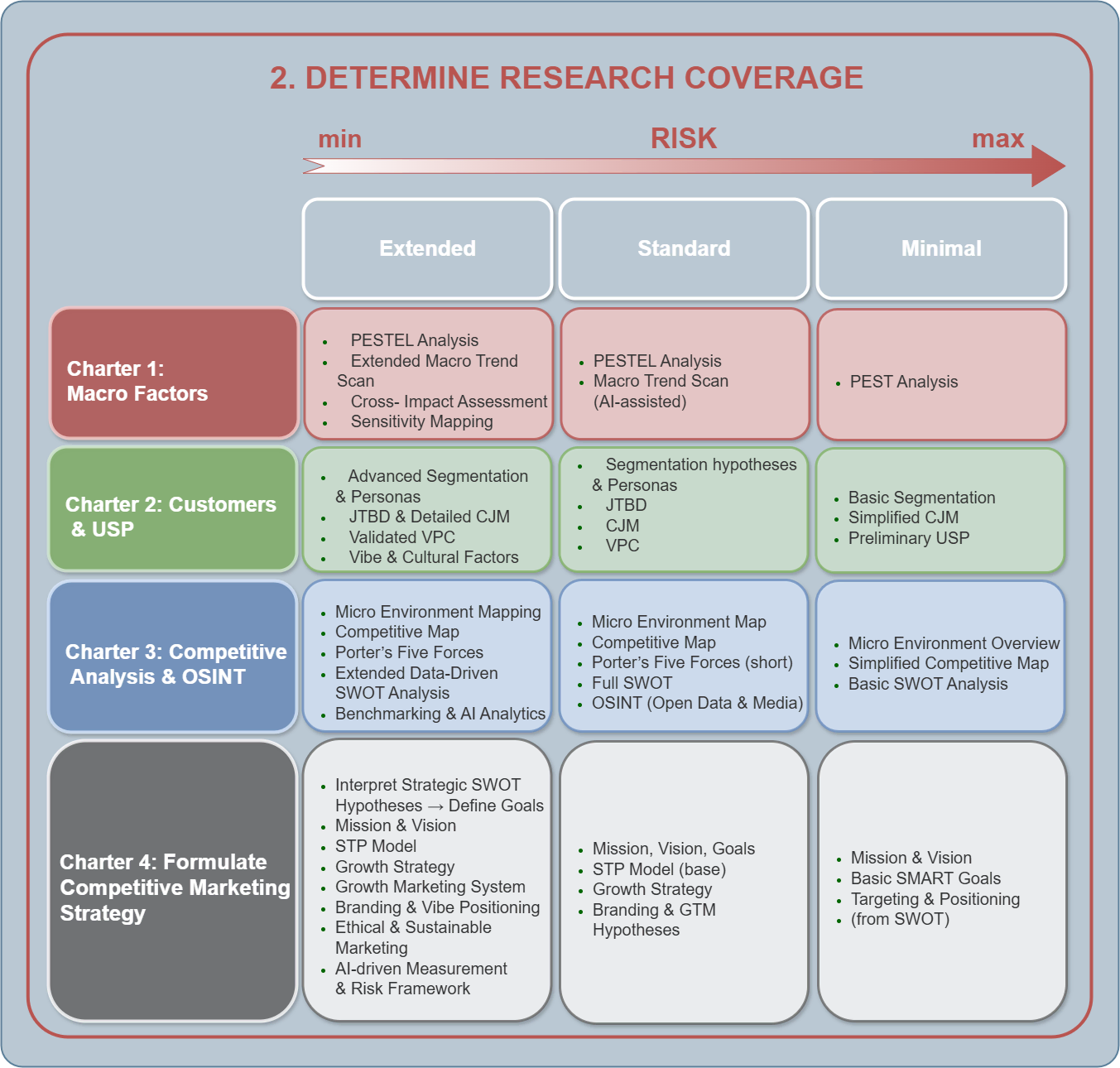
Step 2 — Determine Research Coverage #
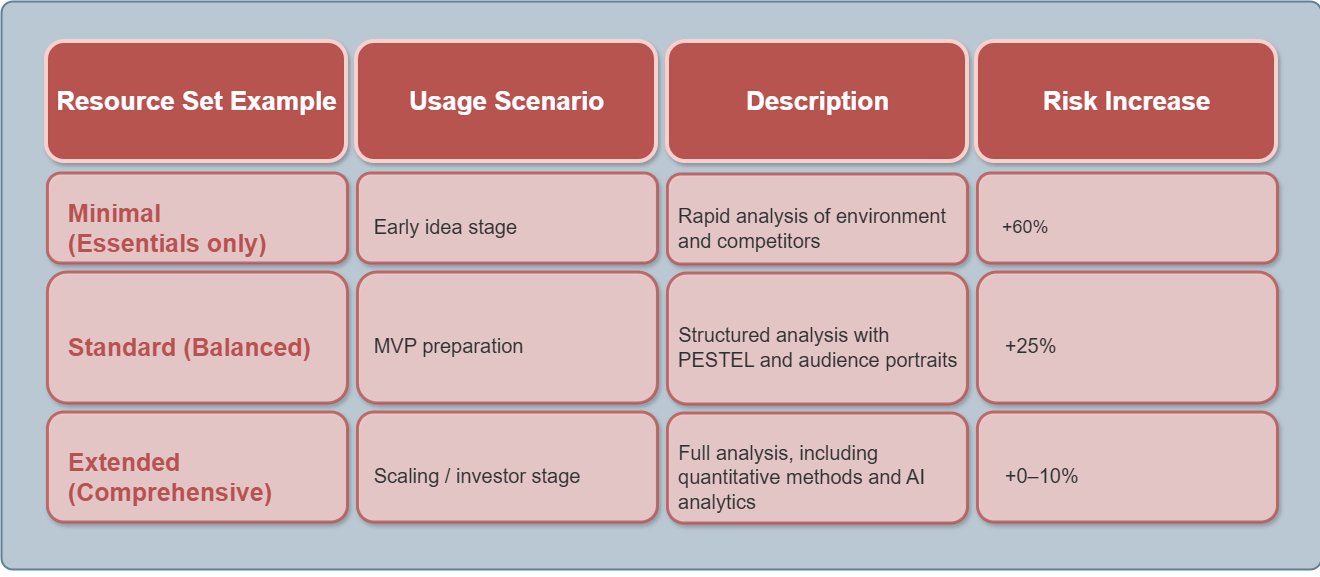
Example: Coverage 60% → Risk +25%. The system recommends adding Customer Validation to reduce uncertainty.
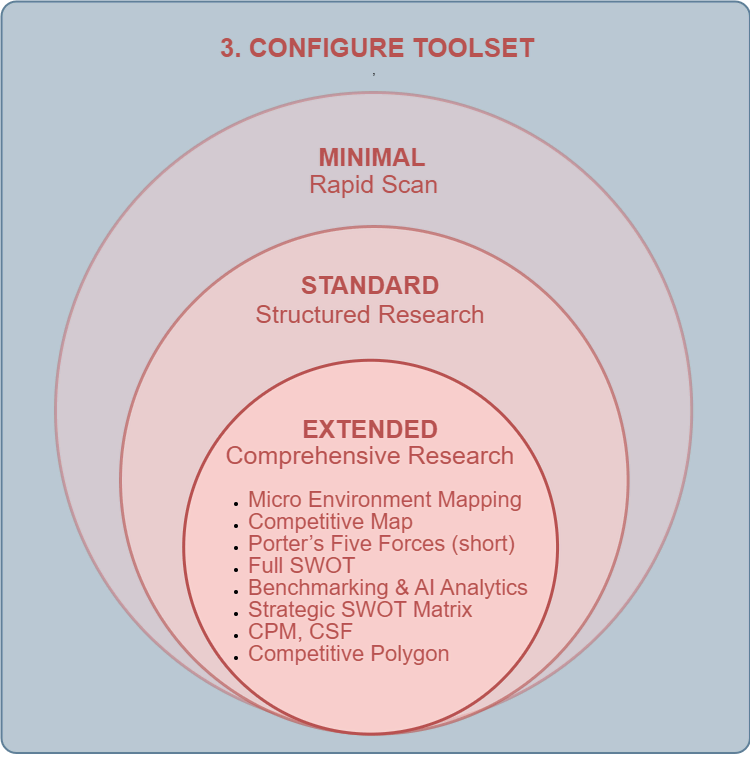
Step 3 — Configure Toolset #
The research process consists of four sequential sections, each of which has three levels of analytical depth. The selected Resource Set determines the amount of data and the degree of detail within each section. Below are three examples of resource sets of different sizes — Extended, Standard, and Minimal — and an illustration of how they define the set of marketing analysis tools across the main sections.
Charter 1. Macro Factors Analysis
 Extended Resource Set:
-

PESTEL Analysis
a full examination of political, economic, social, technological, environmental, and legal factors.
-

Extended Macro Trend Scan
scenario-based trend modeling (STEEP/DESTEP), detection of early signals.
-
Cross-Impact Assessment
analyzing interdependencies between trends (e.g., Tech–Legal, Eco–Social).
-
Sensitivity Mapping
assessing how sensitive the project is to different scenarios.
 Standard Resource Set:
-
PESTEL Analysis (short)
key macro factors.
-
Macro Trend Scan (AI-assisted)
major drivers and barriers.
 Minimal Resource Set:
-
PEST Analysis
political, economic, social, and technological factors.
Outputs from this chapter become inputs for Step 3 (Opportunities & Threats in SWOT).
Charter 2. Customers’ Needs & Unique Selling Proposition

Minimal Resource Set
Minimal Resource Set:
- Segmentation (Light)
- JTBD (Core Job)
- Unique Selling Proposition
Standard Resource Set
Standard Resource Set:
- Segmentation & Personas
- JTBD (Jobs-To-Be-Done)
- Customer Journey Map (CJM)
- Unique Selling Proposition
Extended Resource Set
Extended Resource Set:
- Segmentation & Personas
- JTBD (Jobs-To-Be-Done)
- Customer Journey Map (CJM)
- Unique Selling Proposition
- Vibe & Cultural Factors
Outputs serve as Inputs for Step 3 (Strengths & Weaknesses in SWOT).
Charter 3. Competitive Analysis & OSINT

Minimal Resource Set
Minimal Resource Set:
- Porter’s Five Forces
- Competitive Map
- Basic SWOT Analysis
Standard Resource Set
Standard Resource Set:
- Porter’s Five Forces
- Industry Mapping
- Competitive Map
- Data-Driven SWOT Analysis
- Strategic SWOT Matrix
Extended Resource Set
Extended Resource Set:
- Micro Environment Mapping
- Porter’s Five Forces
- Industry Mapping
- Competitive Map
- Extended Data-Driven SWOT Analysis
- Strategic SWOT Matrix
- OSINT Benchmarking & AI Analytics
Outputs serve as Inputs for Step 4 (Strategy Formulation).
Charter 4. Formulate Competitive Marketing Strategy
Minimal Resource Set
Minimal Resource Set:
- Strategic Goals
- Mission (Light)
- Positioning (STP — Light)
- Core Growth Strategy
Standard Resource Set
Standard Resource Set:
- Strategic Goals (from SWOT)
- Mission & Vision
- STP — Segmentation → Targeting → Positioning
- Growth Strategy (Ansoff Matrix)
- Growth Marketing System
- Branding Positioning
- Measurement & Risk Framework
Extended Resource Set
Extended Resource Set:
- Interpret Strategic SWOT Hypotheses → Strategic Goals
- Mission & Vision
- STP — Segmentation → Targeting → Positioning
- Growth Strategy (Ansoff Matrix)
- Growth Marketing System
- Growth Hacking
- Branding & Vibe Positioning
- Ethical & Sustainable Marketing
- AI‑Driven Measurement & Risk Canvas
Outputs serve as Inputs for Execution Phase (Project Launch & Performance Tracking).
The project step Choose & Approve Research Methods makes the Research phase manageable, transparent, and scalable.
Instead of a static marketing analysis, it forms a dynamic strategic thinking loop, where AI automates routine work and the user focuses on key decisions, approving them with a full understanding of context and risks.
Step 4 — Resource and Time Adjustment #
If resources are limited, the system offers a compromise:
-
Little Time
quantitative methods are excluded, only qualitative methods remain.
-
Limited Budget
AI replaces field research with secondary data.
-

Lack of Data
AI focuses on generating and validating hypotheses.
Each simplification is accompanied by a visual risk indicator:
Selected coverage: 50%. Estimated uncertainty: +30%.
Step 5 — Review and Approval Workflow #
AI performs data collection operations, preliminary analytics, and automatic template filling.
The user reviews, edits, and approves each result.
This format ensures:
-
human control is maintained,
-
decisions remain transparent,
-
AI errors are eliminated through review.
AI is a data-gathering assistant, not a source of final conclusions.
Scenarios of Use #
Results and Benefits #
Choose and Approve Research Methods makes the decision-making process:
-

intentional
risks and trade-offs are visible immediately;
-

adaptive
coverage is adjusted based on resources;
-

intelligent
AI handles routine work while the human approves the meaning;
-

universal
suitable for both startups and corporate teams.
Conclusion #
Modern marketing analysis is not a collection of methods, but a process of integrating data, insights, and decisions.
It enables a project not just to understand the market, but to design its own place within it.
Growth Hacking and Growth Marketing complete this chain, creating a bridge from strategy to continuous growth — from idea to a living product ecosystem.
What a stakeholder should remember when choosing a marketing analysis configuration:
-
Research
is not “just another document,” but a system of interlinked steps: each stage feeds the next.
-
Strategic SWOT Matrix
is a bridge between analytics and strategy: we generate hypotheses at Step 3, and then interpret and prioritize them at Step 4.
-
Communications
are only the tip of the iceberg; the reliability of decisions depends on the quality of the underwater part — research and strategy.
Choose and Approve Research Methods” is an intelligent filter between the idea and the analysis.
It does not replace the research — it transforms it into a manageable, transparent, and measurable process.
Each project receives its own optimal balance between speed and depth,
and the team gains a tool that makes research not a mandatory formality
but a meaningful part of the strategy.
DECISION MATRIX FOR MARKET RESEARCH CONFIGURATION
DECISION MATRIX FOR MARKET RESEARCH CONFIGURATION